Bead damage and what to do about it
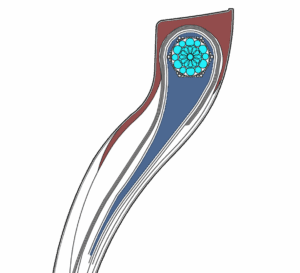 Many tyres are scrapped due to bead damage that is often unnecessary and/ or avoidable. So, how can a bead injury be avoided in the first place? What options are there for repair? Is the process different for bias and radial tyres?
This article answers your questions and looks at how Monaflex bead repair systems can help.
How does the bead damage occur?
The bead area of a tyre can be subject to damage sustained by:
-
Rotation of the tyre on the rim – indexing
- Sometimes, the tyre slips on the rim during a high tractive work. This rotation will generate heating at the level of the bead, accelerate wear to the protective rubber and, in extreme situations, lead to shearing of the reinforced casing ply and separation from the tyre bead.
- Bead injury can be caused by overloading or under-inflation for long periods during use, the mass crushes the tyre, preventing its rotation on the ground which is transferred to the level of the rim; or
- If a tyre is mounted on a rim that is too narrow for the section width.
Key steps: optimise and monitor inflation and double check the rim size
-
Poorly maintained rims

Tyres must only be mounted to rims which have been cleaned and inspected. Poorly maintained rims may cause corrosion at the level of the bead. If the bead is cut, worn or severely damaged, there is a major risk of sudden loss of pressure, resulting in more serious damages.
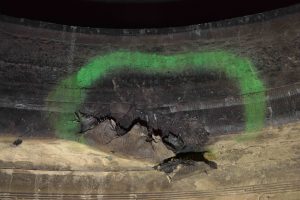
Key steps: rigorous cleaning, inspection and maintenance protocols
-
Break at the end of the reinforced ply
- A fissure between the bead and the sidewall. A separation at the level of the ply turn-ups just above the bead reinforcement – typically due to insufficient inflation pressure.
Key steps: optimising and monitoring tyre inflation
-
Frequent overloading for extended periods
- The edge of the sidewall is pushed against the edge of the rim which initiates the break.
- If the break is in the areas of bead filler, there has been excessive friction in this zone exacerbated by to repeated mounting and dismounting operations, resulting in a structural weakness.
Key steps: ensure load capacities are never breached
-
Handling and mounting damage
- Tyres should not be picked up or handled by the beads using mechanical devices, such as forklifts, without appropriate forklift tine protectors. Tyre manufacturers provide guidelines and recommendations for the correct handling of tyres.
- Mounting and dismounting tyres require experience and proficiency in all facets of tyre assembly and disassembly, whether the task is done manually or with a machine. If the bead is cut, worn or severely damaged, there is a major risk of sudden loss of pressure, resulting in more serious damages.
Key steps: following tyre manufacturing guidelines for handling tyres, staff training and use of appropriate equipment
-
Bead wire break
- A break in the bead wire generally occurs during inflation at the time of the ‘Water Hammer Effect ’. This is the moment when the pressure is sufficient within the tyre to push the beads into their end position in one motion. Generally due to insufficient inflation pressure.
Water Hammer Effect – a pressure surge or wave caused when a fluid in motion, usually a liquid but sometimes also a gas, is forced to stop or change direction suddenly; a momentum change.
-
- This may occur if a new tyre was mounted without using lubricant or if the sides of the bead were not sufficiently lubricated, one of the bead wires may break during the final shock of inflation; or
- If the tyre is overinflated or inflated without the beads seating correctly, a bead which is not positioned correctly may cause a bead wire to break.
- The inflation process is a critical procedure. Seating inflation should never exceed a pressure of 15 psi.
- If you reach this level of pressure and the beads are not correctly positioned, it is much better to deflate the tyre and find out what the problem is rather than destroy a new tyre or, even worse, cause a serious accident linked to rapid expulsion of air.
Key steps: lubricate thoroughly and double check inflation guidelines
Radial vs Bias Ply Tyre Construction
There are key differences between the construction of radial and bias ply tyres and these differences determine the most appropriate repair method.
Radial
A radial tire has cords which run straight across to each bead, perpendicular to the tread face. Furthermore, there are additional plies laid at an angle within the tread face of the tyre only, so a radial tire might only have two layers within the sidewall but five or more in the tread face. Radial tires also usually have steel cords. The construction of a radial tyre is designed to be tough on the tread face but is more vulnerable to impact breaks in the sidewall due to greater flexibility.
Bias Ply
The individual cords which make up each ply or layer within the carcass of a bias tyre run at an angle across the body from one bead to another. The angle varies, between 30° and 38° relative to the face of the tyre. Additional plies run at opposing angles, or in bias, hence the term bias ply. The cords that make up the plies in a bias-ply tyre are usually made of nylon, rayon, polyester, or other non-metallic materials. There are typically multiple plies within the carcass of a bias ply tyre, but the number of plies in the tread face is usually the same as the number of plies in the sidewall. The number of plies will have an impact on the load-carrying capacity of the tyre as well as its resistance to impact breaks.
When can a bead injury be repaired?
Only damage to the bead rubber which exposes the bead bundle or body cords can be repaired. Injuries generally caused by incorrect handling, mounting or dismounting which impede sealing of the tyre or maintaining recommended inflation pressures.
If any part of the bead bundle, body cords or structural components of the tyre are damaged no attempt should be made to repair the tyre, it should be scrapped.
Monaflex for Bead repair
For repairable bead damage of all types, Monaflex offers a solution for use in both Truck and mid range/ XL OTR tyres.
The quick to assemble system uses a single heat pad wrapped around the area to provide uniform temperature whilst the flexible, inflatable airbags ensure perfect conformity to the bead.
Take a look at our systems:
MBRS – mid range OTR bead system for 18.00R25 to 45/65R45
XL BRS – XL OTR bead system for 40.00R57 and 59/85R63
BRS – truck bead system for 8.25 to 12.00R24
Repairing Bias tyres with Monaflex Bead Repair Systems
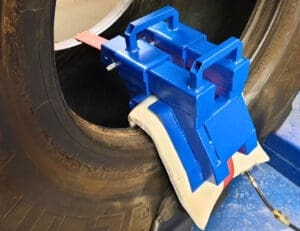
Monaflex OTR and Truck bead repair systems have traditionally been used for radial tyres only but can also be used for repairs to the bead of Bias tyres.
By filling the repair using a chemical cure A & B compound, the Monaflex system can be used to exert pressure on the repair and ensure the strongest possible cure. If you’d like to learn more about this methodology, please just get in touch.
What is the tyre bead?
The bead area of any tyre is made up of a bead bundle, a bead apex filler and a bead chafer. Each has a separate function, yet each piece must rely on the other to function the way tyre design engineers intended. The main function of bead wire is to hold the tyre on the rim and to resist the action of the inflated pressure. Bead wire is the crucial link through which the vehicle load is transferred from rim to the tyre.
The bead is composed of:
-
Bead Bundle
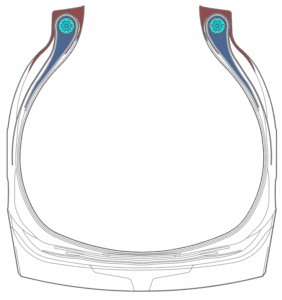 Typically, a bead bundle comprises of numerous large monofilament steel cords. The cord is coated with rubber and then wound into a loop. The loop size is based on the wheel diameter. The resulting bundle is then wrapped with a ribbon of rubber-coated ribbon material. The cords within the bead help the tyre retain its shape and maintain the tyre’s seal as it is subject to distortion and vibration.
-
Bead Fill
At the apex bead filler, a rubber compound, is incorporated within the bead configuration and extends into the sidewall area. The rubber compound used on the outside bead area is usually hard, and durable so as to withstand the rigours of mounting the tyre to the wheel and cut resistance when in service.
Another function of the bead apex filler is to create a smooth contour for the body plies around the bead wire in the lower sidewall area.
-
Bead Chafer
The remaining component in the bead area is the bead chafer, or chafer strip. Its function is to protect the bead area from rim chafing, mounting/dismounting damage and to prevent the tyre from rotating on the rim. Chafer strips are made of a hard, durable compound rugged enough to withstand the forces working against it.
For more information about bead repair and the solutions for bead damage that Monaflex offers, please get in touch on [email protected].
https://youtu.be/LfYYcSTb6w8